
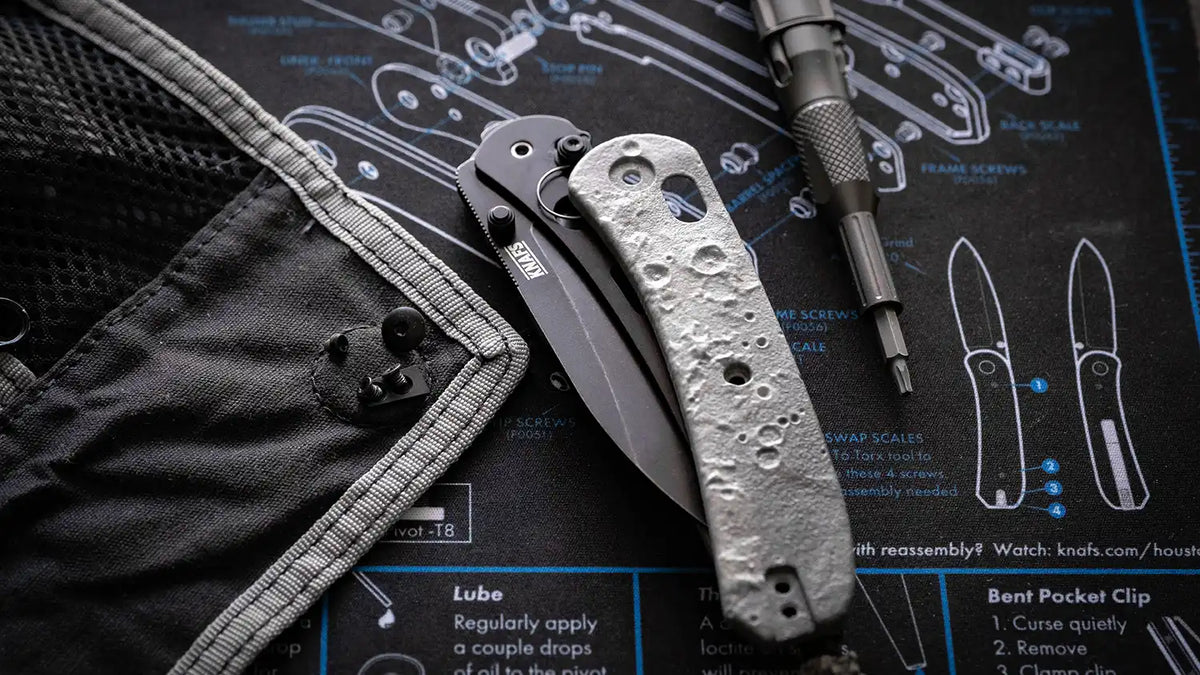
You unbox a fresh blade. It’s shiny, factory-crisp, and practically singing. So naturally, what’s your very first impulse when you walk through the door?
You grab a driver set, tear that poor thing apart down to the bare metal, and dunk the handles straight into a bubbling cauldron of Rit Dye on the stove like some sort of knife-obsessed wizard. Your significant other walks in, sees the kitchen counter covered in tiny screws, pivot lube, and purple goo, and quietly backs out of the room (hey, you could be brewing up something worse, right?).
Look, a plain factory stock knife is fine, but it’s kind of a snooze fest. It looks like every other blade rolling off the assembly line. But the second you dye those scales, slap on an acid wash, or swap out the hardware, it morphs into a one-of-a-kind tool that’s 100% yours.
For decades, big knife companies basically treated us like toddlers. Their rulebook? "Accept this mass-produced gear exactly as it popped out of the shipping container." If you dared loosen a screw, you were met with angry warning stickers, ridiculous proprietary hardware, and scary legal threats about voiding your warranty. Modifying a tool was treated like some wild, reckless crime against resale value.
DIY EDC gear modification isn't just a weekend distraction; it's a full-on revolution.
The Death of Stock Gear & The Right to Repair Tools

Remember when big tech started gluing phone batteries inside so you couldn't swap 'em out yourself? Yeah... who misses that? Ugh. We're getting old. Shh.
While half the tech industry was busy sealing products behind lock and key, the knife world went rogue. People started asking a dead-simple question: why shouldn't I modify my everyday carry gear, even if the factory doesn't want me to?
The answer? Because it’s your stuff! You paid hard-earned cash for it! You oughta be able to rip it apart, flush out three months of pocket lint, swap the scale colors, and tune the pivot when things get sloppy.
It really all comes down to the hardware:
- Proprietary screws: Force you to hunt down bizarre, overpriced tools and strip out if you even look at 'em funny.
- Standard T6 and T8 Torx: Keeps servicing your blade fast, universal, and totally stress-free.
Busting the "Void Your Warranty" Scareware
For ages, taking a pocket knife apart meant kissing your warranty goodbye. If a pivot screw worked itself loose and you dared put a single drop of blue threadlocker on it, some corporate lawyer in a suit would throw an absolute fit.
We think that's garbage. Taking your gear apart shouldn't get you grounded. It should be celebrated! Once you see how the lock bar actually engages the blade tang, a pocket knife stops feeling like a mysterious black box and starts feeling like an awesome piece of mechanical origami.
Standard Hardware = Power to the People
Nothing kills a good Saturday afternoon modding session like running into a weird, 5-pointed, proprietary security screw that no bit on Earth fits.
That’s why sticking to standard Torx T6 and T8 bits is revolutionary for the EDC community. When a maker uses non-weird hardware (ahem, like us), they’re handing power right back to you. You can strip the knife down, clean out trail dust, tune the action, and put it all back together before your coffee gets cold.
Gateway Mods: How to Start Modding Without Blowing Up Your Kitchen

You don't need a $50,000 CNC machine, a mechanical engineering degree, or a garage that looks like NASA mission control to get into DIY EDC gear modification. Honestly? Most entry-level mods happen right at the kitchen table using stuff you already have (or can grab at the hardware store for twenty bucks).
|
Mod Level |
Technique |
Equipment Needed |
Skill Level |
|
Level 1 |
Scale Swaps & Dyeing |
Torx drivers, Rit Dye, pot of hot water |
Beginner (If you can boil water, you can do this) |
|
Level 2 |
Pocket Clip Upgrades |
Screwdriver, new clip |
Easy (Two screws and boom, done!) |
|
Level 3 |
Acid Etching & Stonewashing |
Ferric chloride, mustard, nail polish, tumbler |
Intermediate (Fun, messy science experiment) |
Level 1: Scale Swaps & Rit Dye Magic
Got a set of light-colored handle scales (like Jade G10)? Congrats, you're holding a blank canvas. Drop those bad boys into a pot of synthetic dye on the stove for a couple of minutes, and watch translucent green turn into deep cobalt blue, dark burgundy, or neon orange.
Don't like the final shade? Dye it darker! It’s fast, incredibly satisfying, and virtually impossible to screw up.
Level 2: Pocket Clip Swaps
Stock clips do the job, but slapping on a titanium deep carry clip completely changes how your gear rides in your denim. It sinks the whole handle down below the pocket line so you aren't broadcasting to everyone at the grocery store that you're pocketing a folder. Plus, an anodized titanium clip adds a sweet splash of color to a plain setup.
Level 3: Backyard Acid Etching & Stonewashing
Feeling adventurous? Want to turn that shiny, mirror-polished blade into a battle-tested, dark tactical workhorse? Welcome to the wild world of ferric chloride acid washing.
- Protect the vitals: Dab a little nail polish over the pivot area and blade edge so the crucial tolerances stay intact.
- The bath: Dunk the blade in an acid bath for a few minutes and watch the steel darken right before your eyes.
- The tumble: Toss the etched blade into a plastic jug full of small river rocks and a squirt of WD-40, shake, shake, shake for three minutes, and BAM: instant custom stonewashed finish that hides future scratches like a champ.
(Pro-tip: Keith—aka Moby in disguise—swears by using plain ol' yellow mustard for forcing a rad patina on carbon steel).
The Modder Squad: Open Source Files & Swap Meet Culture

DIY EDC gear modification isn't some lonely hobby you hide in a dark basement. It thrives online, in places like Reddit (r/EDC, r/KnifeSwap), Discord, and Instagram, where folks swap custom parts, help each other fix stripped screws, post CAD files, and flex their latest creations.
It’s a massive global feedback loop. A knife nerd in Utah can design and drop an open-source 3D scale file at breakfast, and by lunch, a maker in Germany has already printed it, slapped it on a blade, and posted a review from their workbench.
Open Source CAD Files = Pure Magic
Picture this: a high school kid prints custom 3D scales in their bedroom using the exact same open-source pocket knife scale CAD files downloaded by a master machinist with decades of experience.
That’s how mods actually work. When brands stop acting like stingy gatekeepers and hand raw design files straight to the community, absolute chaos (the good kind) breaks loose. You end up with hundreds of wild handle designs—from honeycomb textures to glow-in-the-dark resin setups—that the original knife makers never even dreamed of.
The Swap Meet Economy
Custom mods keep gear moving through the community instead of gathering dust in a drawer or sitting in a landfill. Over on forum trade boards, custom pocket knife mods give well-worn tools a second, third, or fourth life.
You pick up a beat-up knife from a guy in Ohio, dye the scales, acid-wash the blade, and swap it to someone in Texas six months down the road. It cuts down on waste and keeps solid, usable tools out on trail, in pockets, and doing real work for years.
Built for Tinkering: The Knafs Advantage
Look, we definitely aren’t rocket scientists, but we sure have some loud opinions about how gear should be made. Knafs was built on a simple, kinda radical idea: when you buy a tool, it's yours. Not ours. Yours. Go buck wild with it! Here’s our thought process:
Numero Uno: The Blank Canvas
We design the base knife using simple, standard hardware and clean geometry so you aren't fighting weird proprietary screws or bizarre angles.
Numero Dos: Open Source Goodness
We throw our 3D CAD files online for free. Print your own scales in PLA, carve them out of scrap wood, or machine them out of solid copper. Go wild!
Numero Tres: The Scaleless Kit
Don't even want our stock scales? Grab a bare-bones base kit and hardware pack so you can build your dream setup from scratch—without paying extra for stock parts you're just gonna toss in a junk drawer anyway.
We don't just tolerate DIY EDC gear modification—we practically beg for it. Whether you're grabbing a replacement screw pack because you dropped a tiny washer into the carpet abyss (happens to all of us), or downloading CAD files to test out a new 3D printer, we're here to help you build something awesome.
We don't want you to just carry our gear. We want you to make it unequivocally, 100% yours.
Boom. Done! Time to Start Building

Tinkering with your daily driver turns a factory-fresh tool into a personal heirloom while teaching you actual, real-deal mechanical skills. It forces you to slow down, get your hands dirty, and solve fun problems on your workbench.
At the end of the day, figuring out how to start modding pocket knives isn't just about flexing sweet custom builds on Instagram. It’s encouraging good ol' fashioned creativity, and true ownership in a world chock full of disposable junk.
Ready to build your first custom setup? Grab a Knafs Scaleless Base Kit and a Bit Driver to kickstart your maker journey!

Dejar un comentario
Este sitio está protegido por hCaptcha y se aplican la Política de privacidad de hCaptcha y los Términos del servicio.